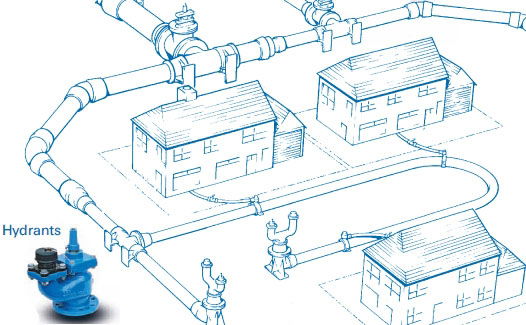
A fire hydrant system consists of water supply pipework and fire hydrant valves that allow fire brigades to connect fire hoses for firefighting operations. Fire hydrant systems are installed in a wide range of locations, including under public roads, in large commercial and industrial buildings, tunnels, chemical plants, onshore and offshore installations, and onboard ships.
Fire hydrant valves and landing valves share a broadly similar design regardless of installation location. They are engineered to be robust, resistant to freezing in harsh environmental conditions, and capable of reliable operation during a fire, in compliance with relevant fire testing and safety regulations. Some fire hydrant valves incorporate a pressure reducing valve to control outlet pressure where inlet pressure varies, which is a requirement in certain fire protection systems. Multiple outlet connection types are available, along with specialist approvals for marine and offshore applications.
In the UK, pressurised water mains installed beneath public roads for domestic and commercial water distribution are also used by fire brigades for firefighting. Underground fire hydrant valves manufactured in accordance with BS 750 are permanently connected to the mains at regular intervals. During firefighting operations, fire hoses are connected to the hydrant valve using a standpipe.
{
Tall buildings and structures should have a permanently installed rising main which consists of a vertical pipe with brigade connections to BS 5041 at different levels of the building.
Types of Riser
There are two types of rising main:
Dry Riser
This is normally dry but is capable of being charged with water by pumping from a fire service appliance via an inlet breaching fitted on the outside of the building at ground level. An air release valve is fitted at the highest point to enable the riser to be fully charged. There are fire hydrant valves on each floor so that the brigade can connect into the water supply at any level of the building.
Wet Riser
A wet riser is a pipe kept permanently charged with water which is then immediately available for use on any floor at which a fire hydrant globe valve (also known as a landing valve) is provided. Wet risers are necessary for buildings (and structure) which are too high for brigade pumps to supply the necessary water pressure via a dry riser. If the mains pressure is higher than maximum brigade operating pressure it is necessary to use pressure regulating landing valves.
Types of Landing Valves
Landing valves connect to the riser and are used to connect the hose to fight the fire. Some landing valves incorporate a reducing valve if the supply pressure is higher than required.
Example Landing Valves (No-built-in regulator / BS336 Instantaneous Female Coupling)
Broady Hydrant Reducing Valve (With built-in Pressure Regulator / BS336 Instantaneous Female Coupling)
Common Connection Types
BS336 Instantaneous Coupling:
BS336 Instantaneous fire hose couplings (also known as Morris couplings), are the standard low pressure fire hose fitting for UK fire brigades. They have a male and a female end and are a push fit. Max Working Pressure 15 Bar.
Storz Coupling:
This coupling type was originally patented in Switzerland but is now widely used in the US and Europe. Benefit of this connection type is that every end is identical and can be joined to any other end of the same diameter. To couple a Storz connection, the two opposing couplings are pressed together such that the hooks of each one are inserted into the slots in the flange of the other. Then they are rotated in opposite directions until they are tight, or latches engage. Many other coupling designs are based around this design. Working pressure 16 bar.
NOR Coupling:
Symmetric coupling (Storz type) designed according to Norwegian standard. Working pressure 10 bar.
ROTTA Coupling:
Symmetric coupling (Storz type) designed according to Russian ROTTA ROTH standard. Working pressure 10 bar
For further help or information about these products, please contact us on +44 (0)1482 601030 or email sales@flowstar.co.uk.